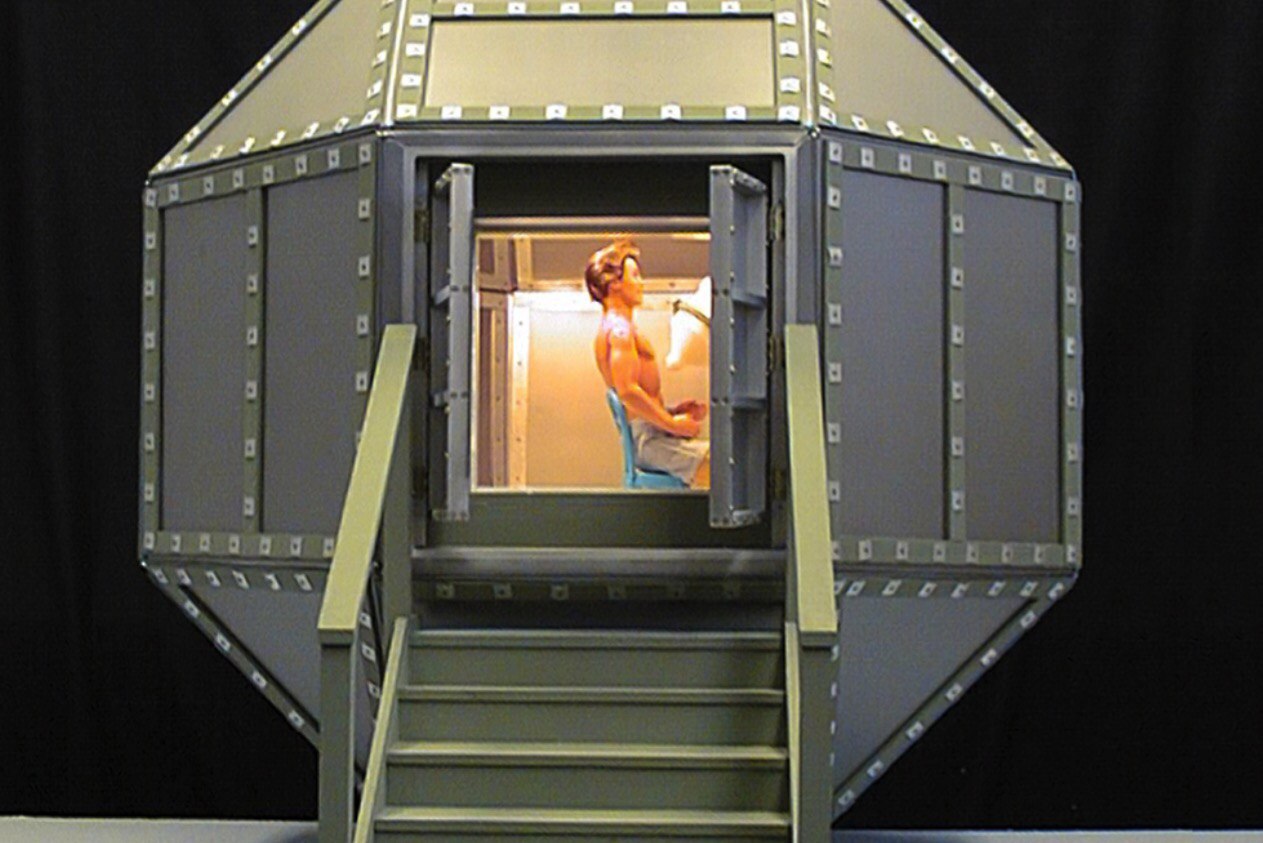
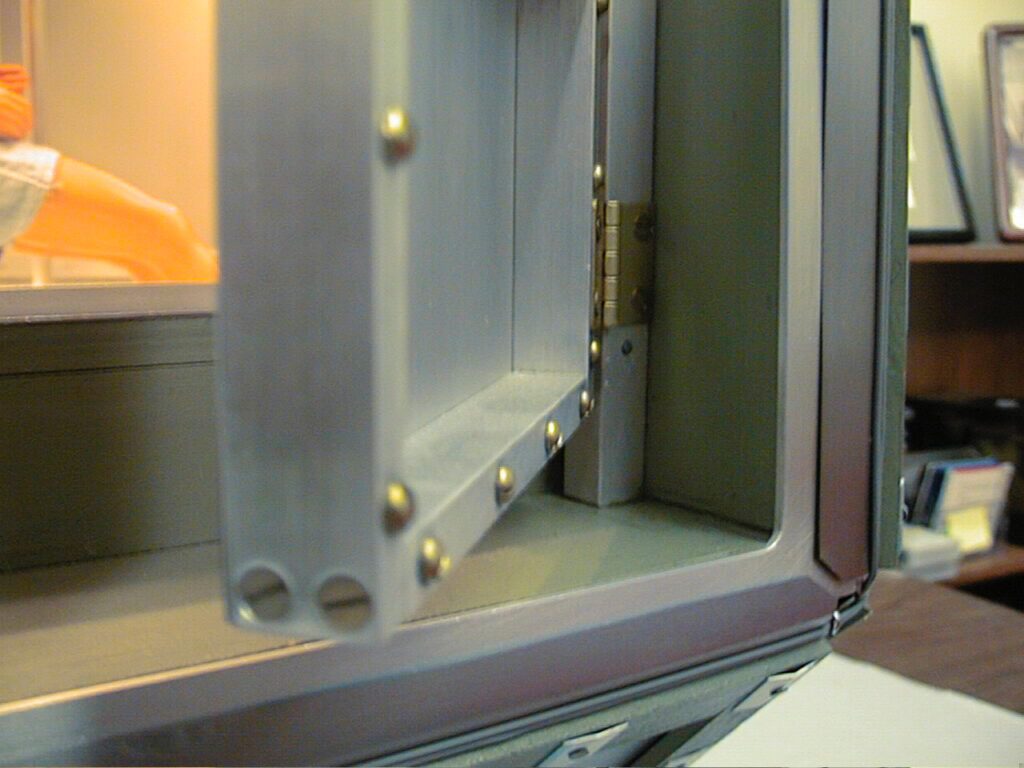
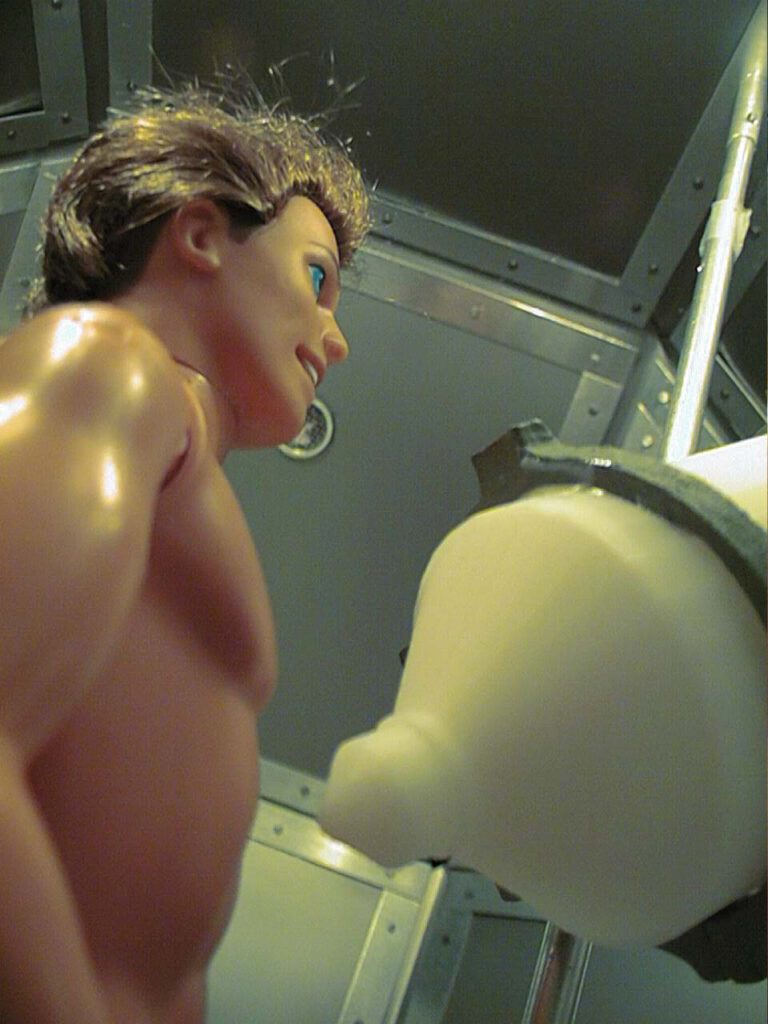
Scale museum model for Dr. David Cohen at Martinos Center for Biomedical Imaging.
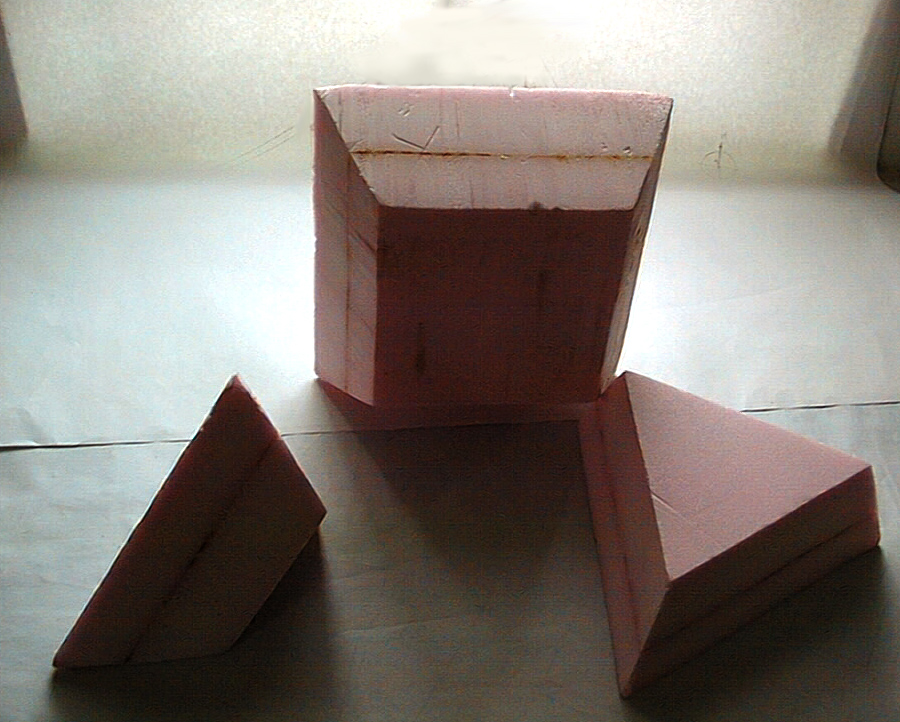
By 1993, with advances in equipment and need for space, the full-size shielded room was to be moved out of its lab space at MIT. Before disassembly and storage, Dr. Cohen decided to have a detailed museum model built at 1:6 scale. Roll of David Hamby in model making: Collaborate with the inventor and original builder to determine which details and materials to replicate. Managing fabrication and assembly of about ten-thousand pieces, including use of 3D-printer. Model was offered to the MIT Museum but is now on permanent display nearby at the Martinos Center for Biomedical Imaging.
Background:
Dr. David Cohen, in an earlier career, worked as an accelerator physicist specializing in strong magnetic fields and using heavy nuclear shielding. Interested in the other extreme, he turned to measurement of very weak magnetic fields—the kind of fields naturally generated by the human body.
Earlier, in 1963, a group in Syracuse reported the first measurement of the magnetic field of the human heart, but the signal was barely readable over the background noise. After building a simple shielded room for clearer signals from the heart’s magnetic field, Dr. Cohen also measured the much weaker field of the human brain. This was the first magnetoencepahalogram (MEG).
Then, in 1969, he moved to MIT, to construct a more elaborate shielded room, in the form of a faceted pod, a nickel-paneled rhombicuboctahedron. James Zimmerman brought in his extremely sensitive detector called the SQUID (Superconducting Quantum Interference Device). Cohen and Zimmerman set up this detector inside the new room, to look at the body’s heart signal, the MCG. For the first time the signals were now clear, opening the way for other researchers.
He continues active at the Martinos Center for Biomedical Imaging. In a May 2013 issue of the journal Review of Scientific Instruments, Cohen and Sheraz Khan, reported the magnetic field of the wall of a new shielded room in the Center’s MEG facility: an almost unimaginable 0.5 femtotesla/√Hz. The weakest magnetic field ever measured.